3D Cantilever
A full 3D topology optimisation of a short cantilever beam (60 × 30 × 30) using the Free 3D GGP formulation. Each component is parameterised by eight variables (centre position, length, width, two orientation angles, and a density parameter), allowing arbitrary 3D orientations.
Running
ggp optimize --preset 3d_cantilever
To save the density image:
ggp optimize --preset 3d_cantilever --output-dir docs/_static
The preset uses the AMJax FEM solver by default (fem_solver: amjax),
which is JIT-compiled, GPU-compatible, and handles 3-D systems efficiently.
The first iteration incurs a one-time JAX compilation overhead (~1–2 s);
subsequent solves are fast. To fall back to the PETSc iterative solver:
ggp optimize --preset 3d_cantilever --fem-solver iterative
Result
The figure below shows four views of the optimised 3D density field (isosurface at ρ = 0.5, i.e. solid material only): isometric, front (XY plane), top (XZ plane), and side (YZ plane). The green face marks the fixed boundary condition; the red dot and arrow mark the applied point load at the mid-right face.
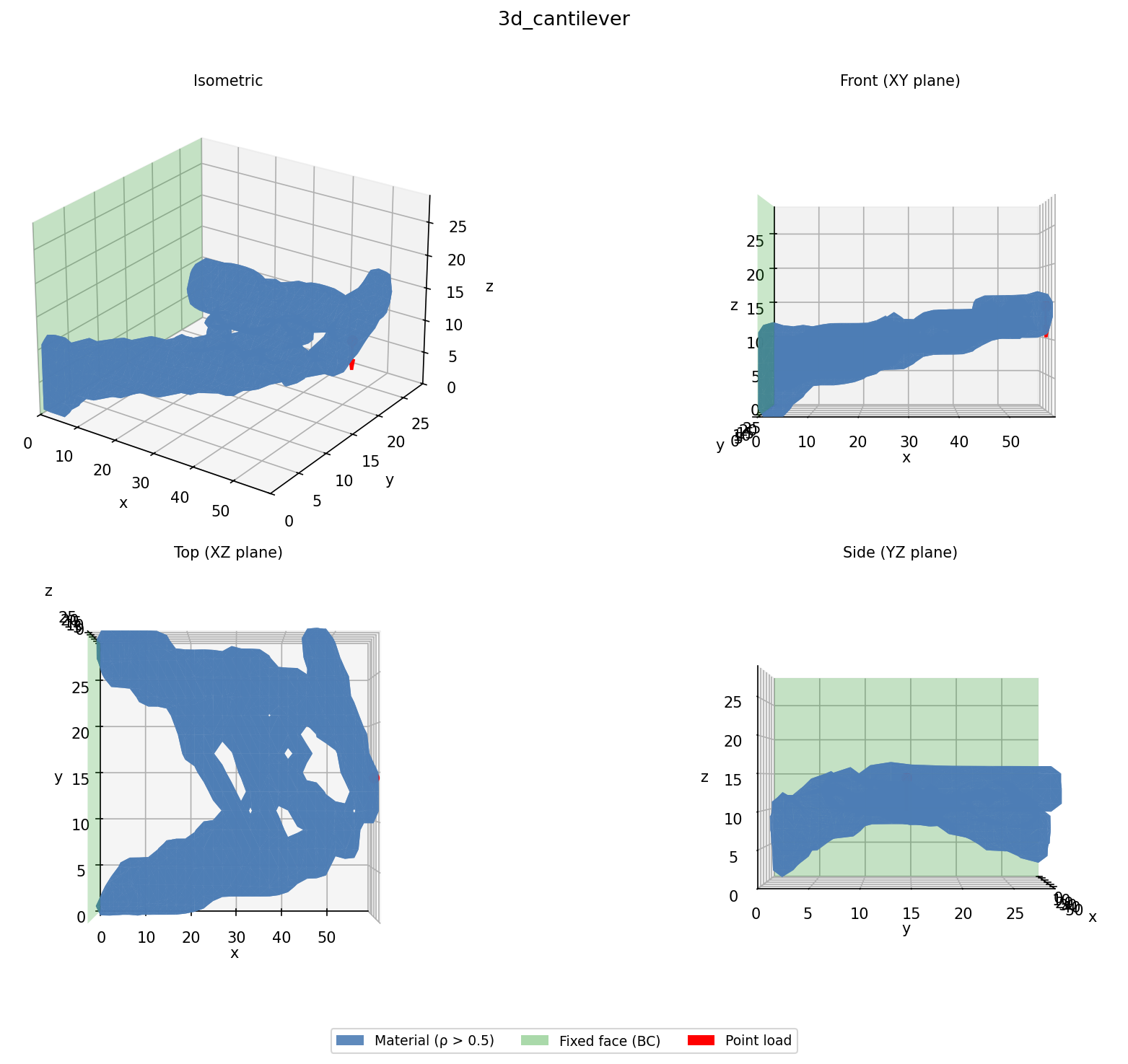
Four-view isosurface (ρ > 0.5) of the optimised 3D density field after 150 MMA iterations (10 % volume fraction).
Problem details
Parameter |
Value |
|---|---|
Domain |
60 × 30 × 30 |
Mesh |
30×15×15 tets |
Formulation |
Free 3D |
Components |
20 |
Volume fraction |
0.10 |
Algorithm |
MMA |
Max iterations |
150 |