gemseo-box-subdivision#
gemseo-box-subdivision is a GEMSEO plugin for the study of optimization algorithms. Its algorithms are registered in the GEMSEO factories and can be used wherever a GEMSEO algorithm name is expected, without importing the package explicitly.
The package implements the box-subdivision outer approximation, a bi-level method for multimodal nonlinear problems in which the exploration of the design space and the local optimization within a region are carried out at two distinct levels.
pip install gemseo-box-subdivision
The separation of exploration and exploitation, the bi-level formulation and the role of the convexification.
The components, their common one-hot layout, and two errors that produce no warning.
Construction of a GEMSEO scenario with either formulation, and the main settings.
Comparison with the enumeration of the boxes, with multistart, CMA-ES, DIRECT and EGO, and an application to topology optimization.
Summary of the results and directions for further work.
Overview#
The method solves
where a mixed-integer master problem selects a box through the one-hot vector \(\alpha\) and a local nonlinear solver solves the original problem within it.
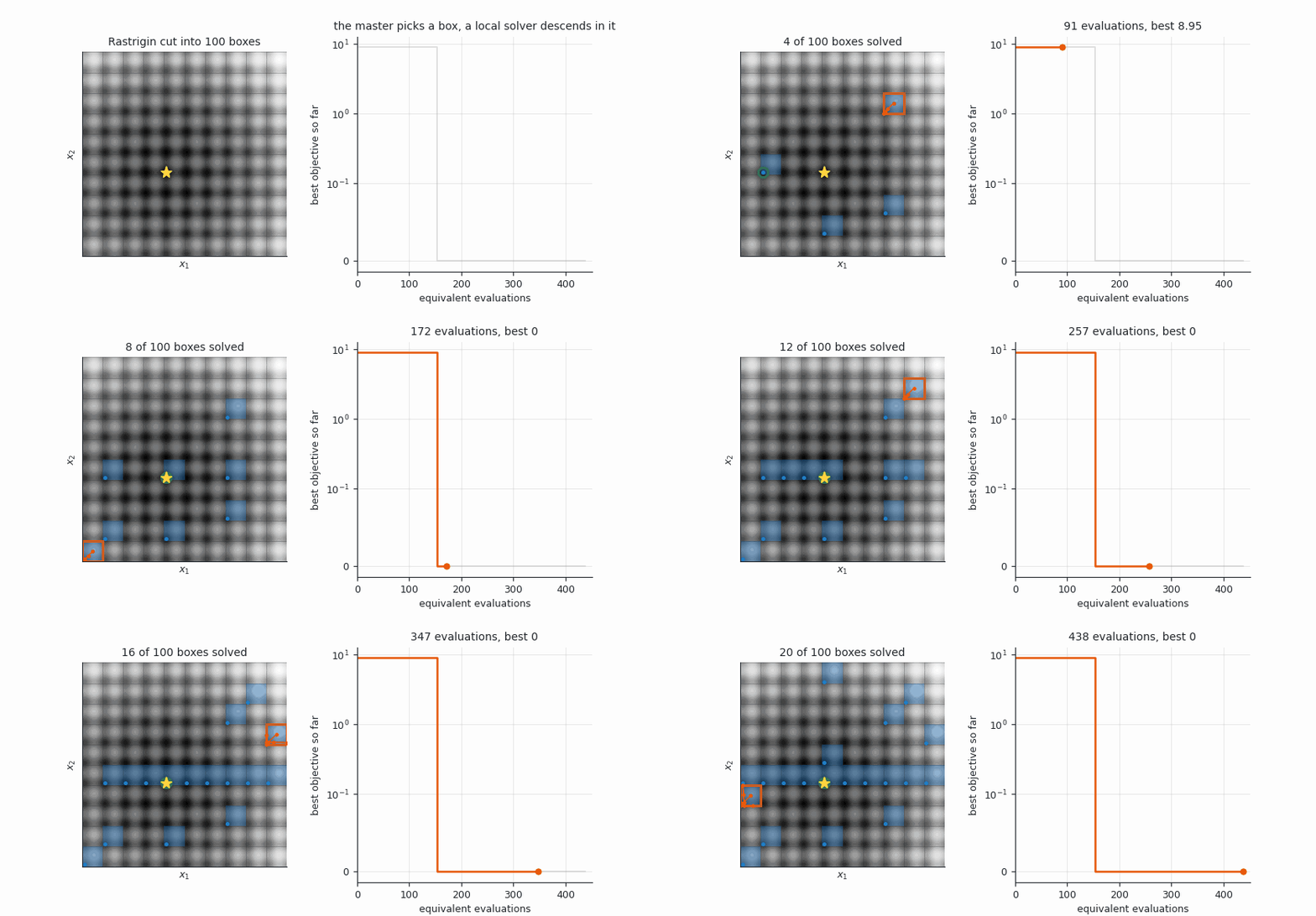
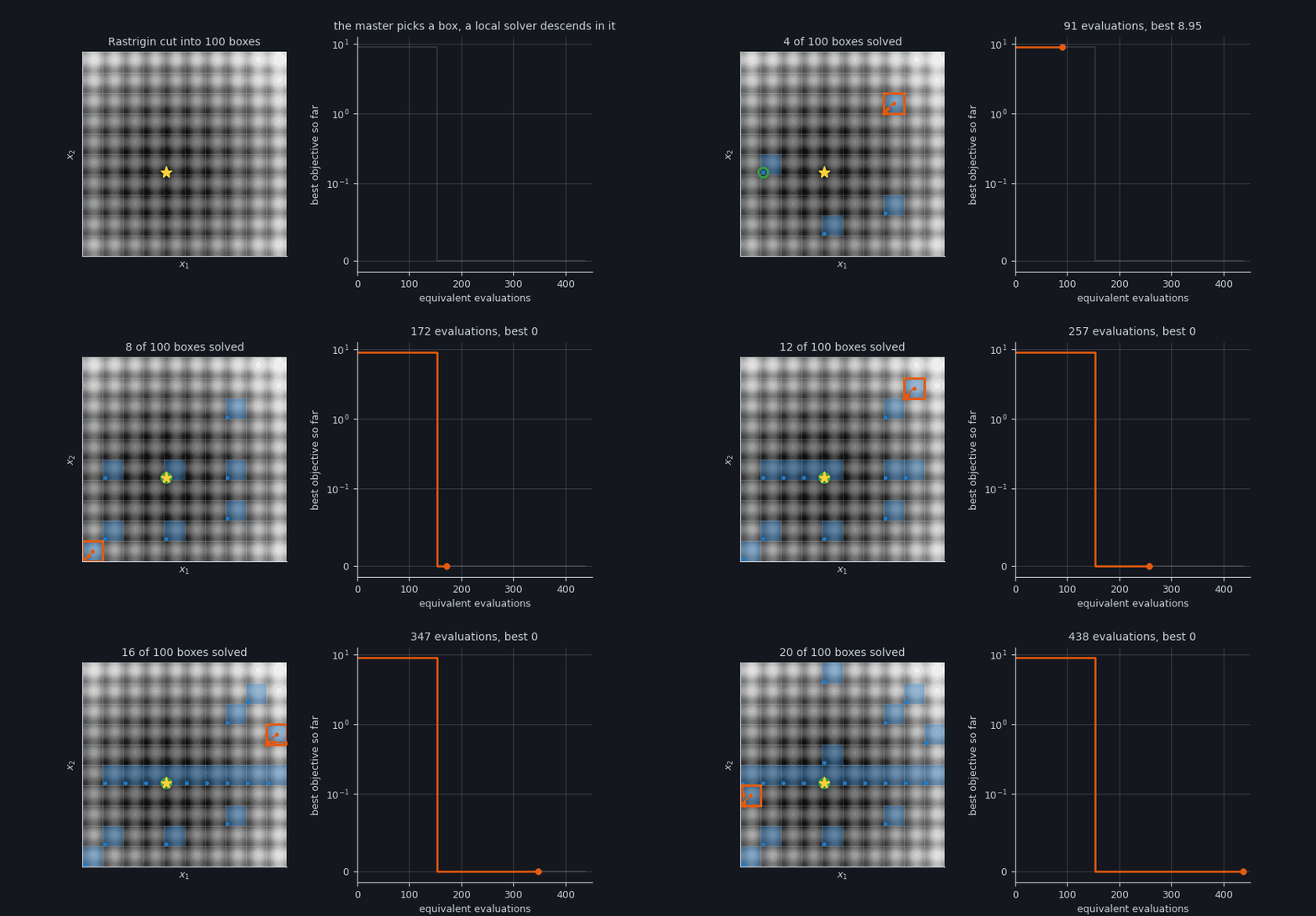
Figure 1. Rastrigin function in two dimensions, subdivided into \(100\) boxes, solved with the default settings. Each frame adds one box: the box selected by the master (orange) with the path of the local solver, the boxes already solved (blue) and the incumbent (green circle).
In the run of Figure 1, the global optimum is found in the seventh box, after \(154\) evaluations; the run terminates on its stopping criterion after twenty boxes and \(438\) evaluations.
Note
The method applies to problems whose basins can be separated by a subdivision of the design space. The subdivision must be fine enough to place the basins in different boxes, and coarse enough for the number of binaries to remain below the number of sub-problems the budget allows, about fifty in the experiments of this documentation. With ten subdivisions per variable, the Rastrigin function in five dimensions satisfies both conditions and its optimum is reached from all starting points; with the same density, each basin of Styblinski-Tang is divided into five boxes and the results degrade. See the density of the subdivision.
Tip
The cuts of the outer approximation are valid only for a convex value function.
The corresponding safeguards of the master are disabled by default, in which case
a run typically terminates after two or three sub-problems far from the optimum.
Both safeguards are expressed in the units of the objective, which are generally
unknown before the run. SweptBoxSubdivisionSettings() requires no such value: it
assigns a ladder of convexity values to the probes of the master. In the
experiments it performs as well as the calibrated configuration on all problems
and is more reliable on two of them. See
Usage and
the results.