Annex A: the benchmark problems#
The analytic experiments use four classical multimodal test functions and one
function defined for this package. They are implemented in
benchmarks/problems.py together with their gradients, which were verified
against central finite differences.
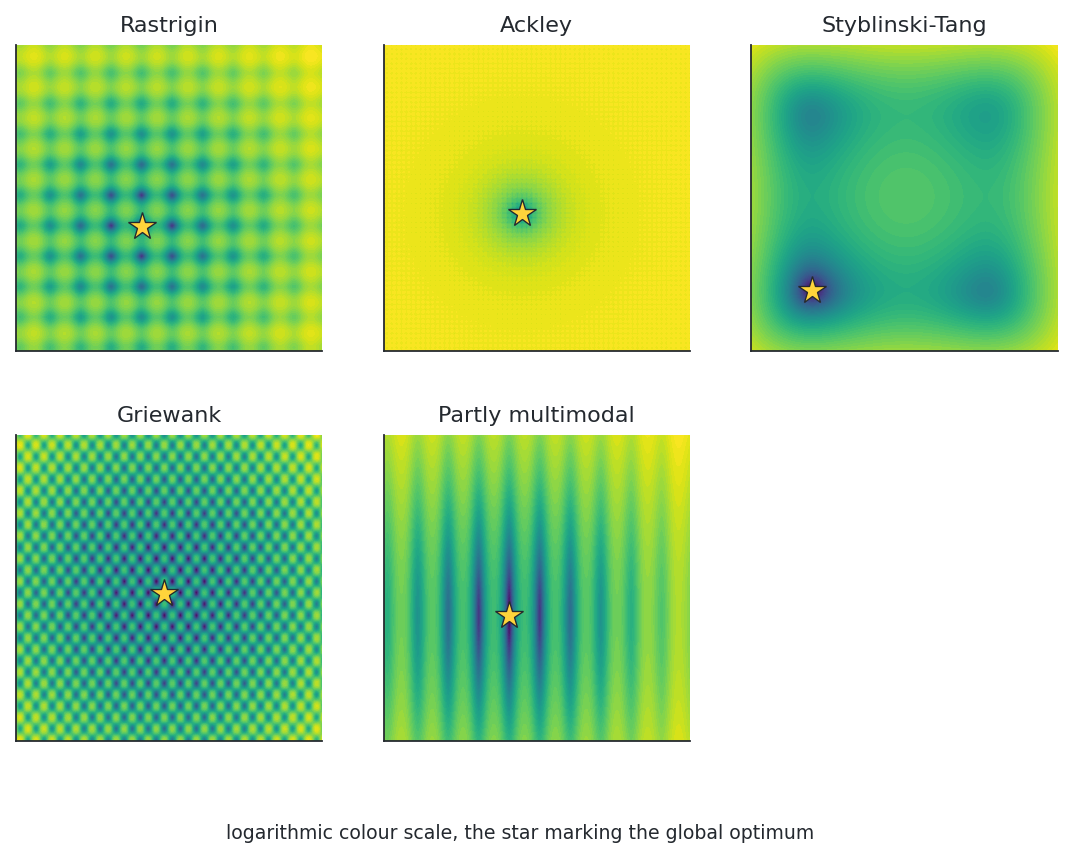
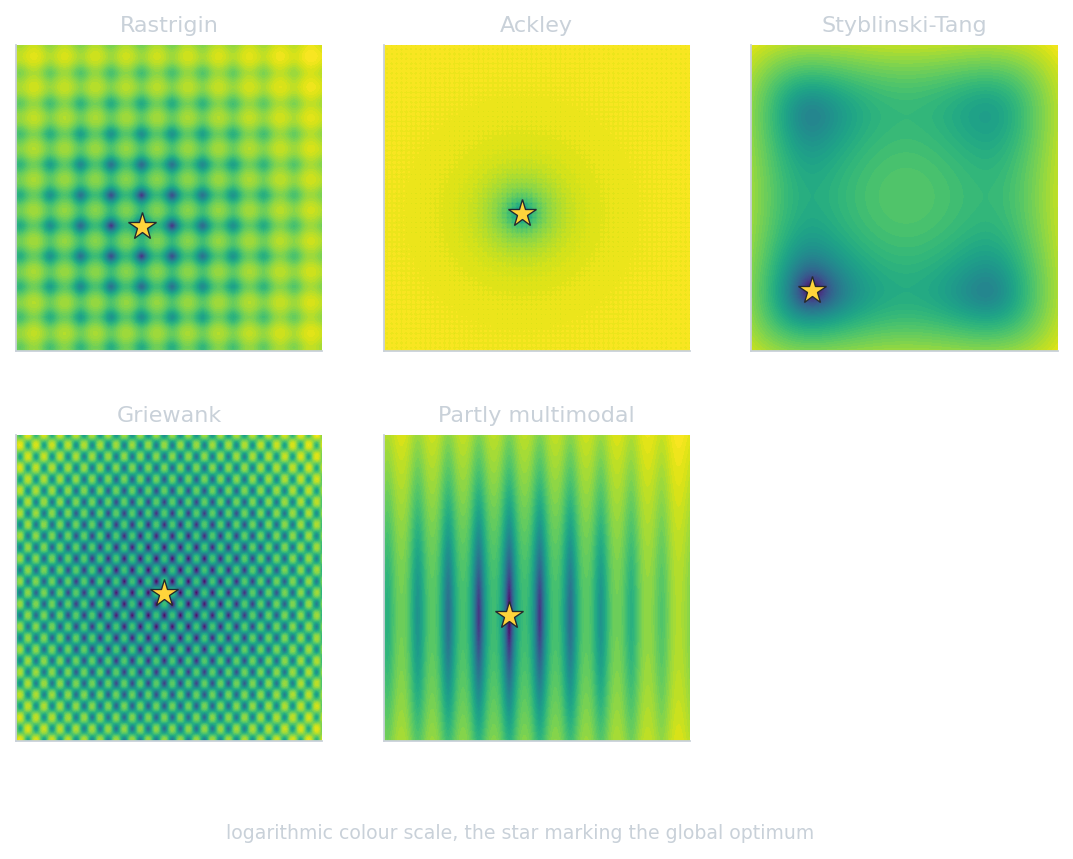
Figure A.1. The five test problems in two dimensions.
The bounds are asymmetric, so that the global minimizer lies neither at the centre nor on the boundary of a box, which would favour a method based on a subdivision of the design space.
problem |
definition |
bounds |
global minimum |
|---|---|---|---|
Rastrigin |
\(10n + \sum_i \left(x_i^2 - 10\cos 2\pi x_i\right)\) |
\([-4.1, 5.9]^n\) |
\(0\) at the origin |
Ackley |
\(-20 e^{-0.2\sqrt{\frac1n \sum_i x_i^2}} - e^{\frac1n \sum_i \cos 2\pi x_i} + 20 + e\) |
\([-28.7, 34.9]^n\) |
\(0\) at the origin |
Styblinski-Tang |
\(\frac12 \sum_i \left(x_i^4 - 16 x_i^2 + 5 x_i\right)\) |
\([-4.9, 5.1]^n\) |
\(-39.166 \, n\) at \(x_i = -2.904\) |
Griewank |
\(1 + \frac{1}{4000}\sum_i x_i^2 - \prod_i \cos \frac{x_i}{\sqrt i}\) |
\([-58.1, 61.9]^n\) |
\(0\) at the origin |
Partly multimodal |
\(\sum_{i \le 2} \left(10 + x_i^2 - 10 \cos 2\pi x_i\right) + \sum_{i > 2} x_i^2\) |
\([-4.1, 5.9]^n\) |
\(0\) at the origin |
Table A.1. Definitions, bounds and global minima.
Characteristics of the problems#
The Rastrigin function (Rastrigin, 1974; Törn and Žilinskas, 1989) has local minima about one unit apart over a range of ten, i.e. about \(10^n\) minima; a box contains a single minimum only when the subdivision is fine.
The Ackley function (Ackley, 1987) has a single broad basin over a range of sixty, with a fine ripple superimposed. A coarse box is multimodal and a fine box is almost flat, so that the ranking of the boxes is difficult in both cases.
The Styblinski-Tang function (Styblinski and Tang, 1990) has two deep and well separated basins per variable, i.e. \(2^n\) basins. This is the type of landscape for which the method is designed, and the problem it solves at the lowest cost.
The Griewank function (Griewank, 1981) is a paraboloid of range about two with a product of cosines superimposed. Its minima are dense and of almost equal value, so that only a very fine subdivision separates them; no method of the comparison reaches its optimum.
The partly multimodal function is the Rastrigin function in the first two variables and a paraboloid in the others. It is used to evaluate a subdivision of a subset of the variables, which is of no use for the classical functions, all multimodal in every variable.
Spacing of the basins#
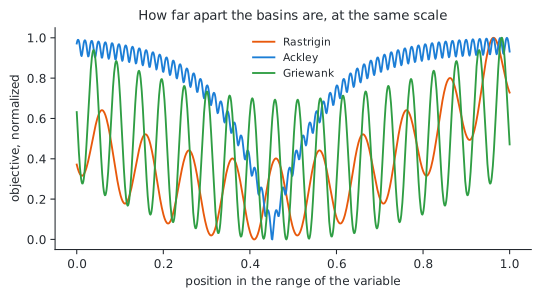
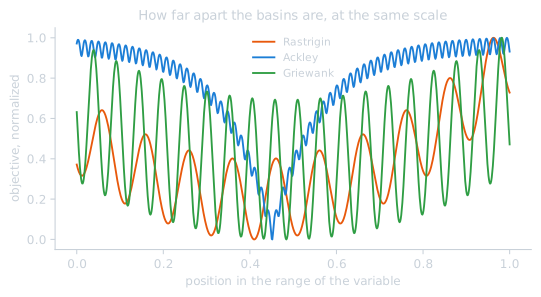
Figure A.2. One-dimensional slices of three problems, normalized to a common range.
After normalization to a common range, the three problems of Figure A.2 differ in the spacing of their basins rather than in their depth. This spacing determines the subdivision required, see the results.
References#
Rastrigin, L. A. (1974). Systems of Extremal Control. Nauka, Moscow.
Törn, A., & Žilinskas, A. (1989). Global Optimization. Lecture Notes in Computer Science 350, Springer.
Ackley, D. H. (1987). A Connectionist Machine for Genetic Hillclimbing. Kluwer Academic Publishers.
Styblinski, M. A., & Tang, T.-S. (1990). Experiments in nonconvex optimization: stochastic approximation with function smoothing and simulated annealing. Neural Networks, 3(4), 467-483.
Griewank, A. O. (1981). Generalized descent for global optimization. Journal of Optimization Theory and Applications, 34(1), 11-39.
Jamil, M., & Yang, X.-S. (2013). A literature survey of benchmark functions for global optimization problems. International Journal of Mathematical Modelling and Numerical Optimisation, 4(2), 150-194.